
How the World Wide Web Began at CERN
A research problem with a worldwide answer
The World Wide Web began at CERN, the particle physics laboratory near Geneva, Switzerland. Researchers needed a simpler way to share and find information stored on different computers. English computer scientist Tim Berners-Lee proposed a system that would connect documents through links, making information easier to navigate.
He submitted his initial proposal in March 1989. His supervisor, Mike Sendall, wrote “Vague but exciting” on it—a memorable response to an idea whose eventual reach was far from obvious.
The Web is not the Internet
The two terms are often used interchangeably, but they describe different things:
- The Internet is the global network of interconnected computer networks and the infrastructure that carries data between them.
- The World Wide Web is a system of linked pages and resources accessed over that network, typically through a browser.
The Internet already existed when the Web was developed. Other services, including email, can use the Internet without being part of the Web.
The first browser and server
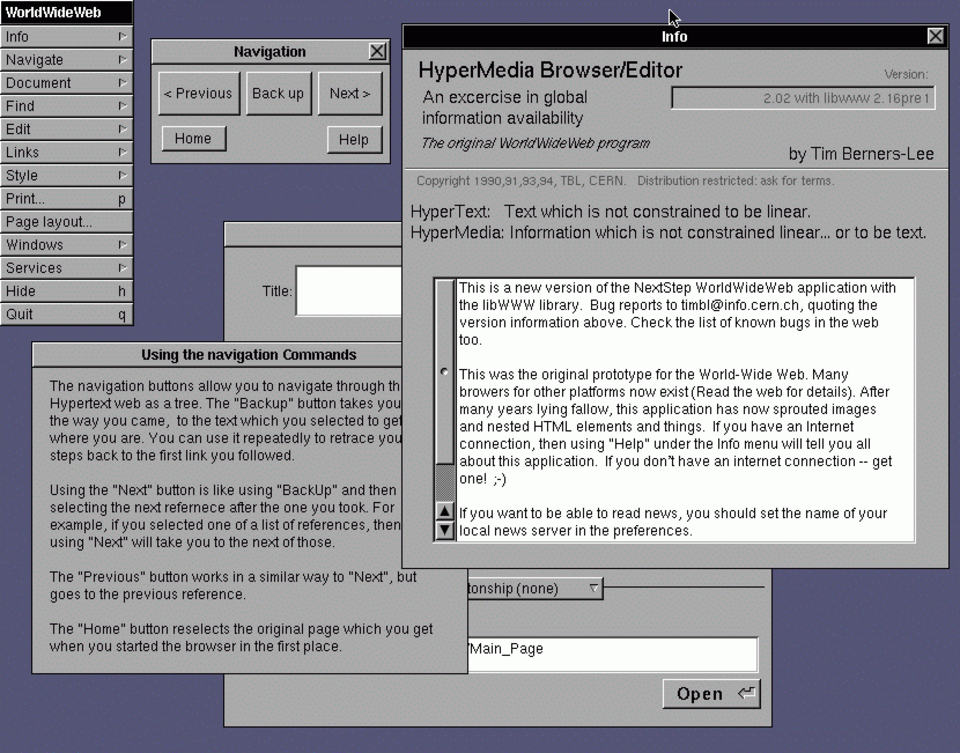
By the end of 1990, Berners-Lee had built the first web browser and web server. His browser was named WorldWideWeb, written as a single word. It also allowed users to edit pages and was later renamed Nexus to distinguish the application from the wider Web.
The first server ran on a NeXT computer at CERN. A handwritten warning on the machine told colleagues not to switch it off: shutting down this computer would also shut down the service it hosted.
The decision that opened the door
In April 1993, CERN made the Web software available royalty-free. People could use the technology without paying CERN licensing fees, removing an important obstacle to adoption.
This openness helped the Web expand beyond scientific research into publishing, education, business and everyday communication.
A coffee pot joins the story
Another early networking experiment took place at Cambridge University. In 1991, researchers set up a camera to monitor a coffee pot remotely, avoiding wasted trips when it was empty. Initially accessible on a local network, the camera became available through the Web in 1993—an early demonstration that online information could solve very ordinary problems.
Key facts
- Tim Berners-Lee submitted his first Web proposal at CERN in March 1989.
- The Web is a system of linked pages and resources that operates over the Internet.
- The first web browser was called WorldWideWeb and was later renamed Nexus.
- The first web server ran on a NeXT computer at CERN.
- CERN released the Web software royalty-free in April 1993.

Test your knowledge
Ready to quiz yourself on Science & Innovation? Take the quiz now!
Start Quiz →Published by WizdomMaster · Educational content for quiz enthusiasts