
The Eight Banners: The Organization Behind Qing Power
An Army and a Social Order
The Eight Banners, known in Chinese as Bāqí, were central to the rise of the Qing Dynasty. They did more than organize soldiers: they registered households, distributed resources, and tied communities to the ruling dynasty. This combination gave Qing rulers a durable framework for mobilizing people and maintaining loyalty.
From Hunting Groups to Eight Banners
The system grew out of Manchu traditions of collective hunting and warfare. Its basic organizational unit was the niru, which became a building block of the larger banner structure.
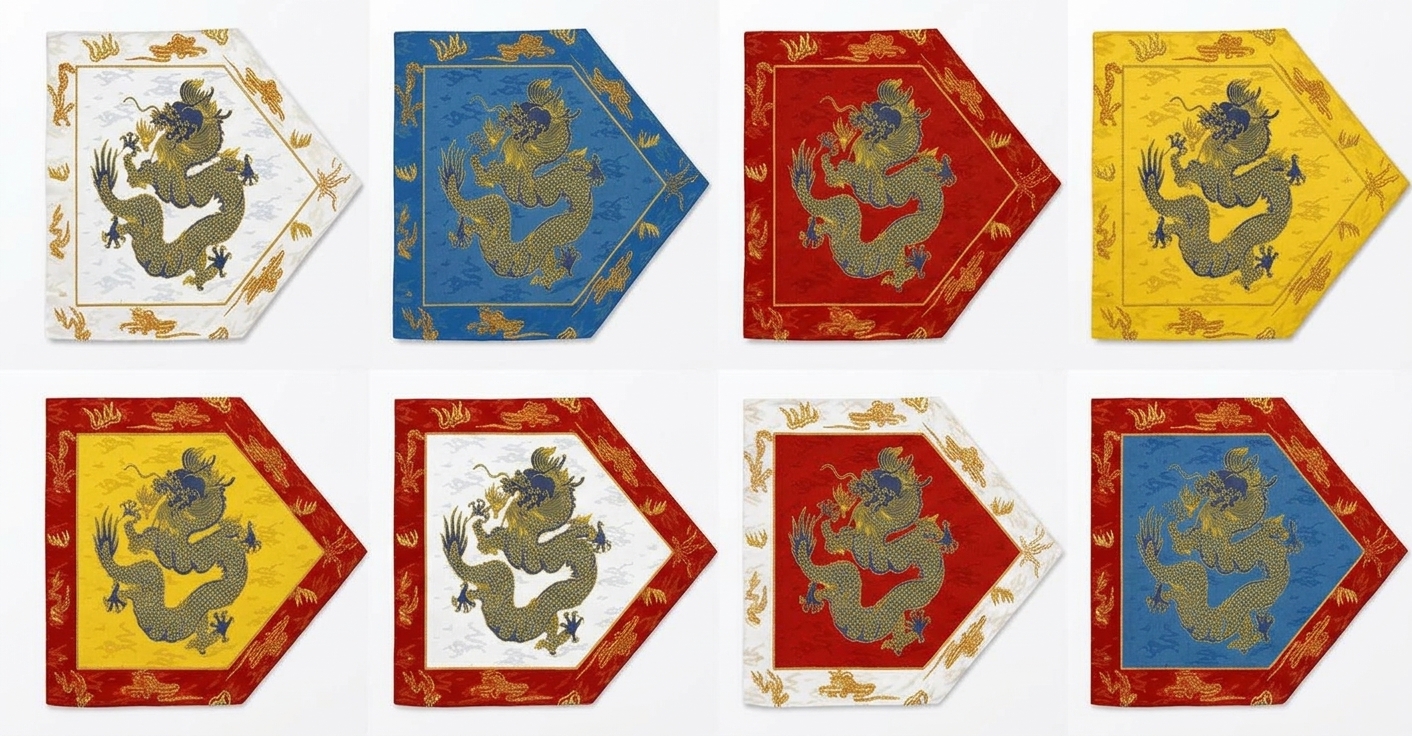
Nurhaci, the leader who laid the foundations for Qing power, initially organized four banners. In 1615, he expanded them to eight by adding a bordered counterpart to each original color.
- Plain Yellow and Bordered Yellow
- Plain White and Bordered White
- Plain Red and Bordered Red
- Plain Blue and Bordered Blue
Why Eight Became Twenty-Four
As the organization expanded, it incorporated Mongol and Han Chinese followers alongside the Manchus. Separate sets of eight banners emerged for each of these three groups, producing 24 banner groupings. These were broad administrative and military categories, not simply 24 individual regiments.
Different troops contributed different strengths. Manchu and Mongol forces were particularly associated with mounted archery, while Han Chinese banner soldiers made important contributions through infantry service, firearms, and heavy artillery. Artillery was especially valuable in attacks on fortified Ming positions.
Membership Shaped Everyday Life
Banner affiliation was generally inherited. It governed household registration and could influence residence, education, livelihood, and access to official service. Banner communities included soldiers and their families, so membership was not the same as being an active combatant.
Serving bannermen received state support that could include grain allowances, silver payments, and access to land. In return, the dynasty expected military or official service. Restrictions on civilian occupations were intended to preserve this service role, although regulations and actual practices varied across periods and places.
Imperial Favor and Urban Geography
Banner status was not entirely fixed. A process called taiqi, or “raising the banner,” allowed selected individuals or families to move into higher-status banner affiliations through imperial favor. Such promotions could involve relatives of imperial consorts and, in some cases, transfer into Manchu banners.
After taking Beijing, the Qing established banner residential and garrison zones in the Inner City around the imperial palace. The arrangement placed military communities close to the political center and gave banner affiliation a visible place in the capital’s geography.
Declining Military Effectiveness
Over time, hereditary privileges and reliance on state support contributed to declining readiness in many banner forces. By the nineteenth century, their battlefield effectiveness had weakened considerably. The organization that had helped secure Qing rule struggled to meet the demands of changing warfare.
Key facts
- Nurhaci expanded four banners into eight in 1615.
- The banner colors were yellow, white, red, and blue, each with a bordered counterpart.
- The system developed separate Manchu, Mongol, and Han Chinese banner organizations.
- Banner membership was generally hereditary and extended beyond military service.
- Han Chinese banner troops played an important role in artillery and siege warfare.
Test your knowledge
Ready to quiz yourself on History & Heritage? Take the quiz now!
Start Quiz →Published by WizdomMaster · Educational content for quiz enthusiasts